http://www.tenement.org/folksongs/client/
sound map!
this was just one of the sidebar links to the google-maps-killed-bambi article.
it's also really pretty to listen to, i think.
Thursday, August 6, 2009

eyesight as material --> affectivity as a reading of this material?
That article about blinking is really cool. This info about synchronized blinking inspires some pretty paranoid conclusions. I think this reveals the extent to which the visual sense is seen as the ultimate conqueror of space, the ultimate/unproblematic linking of navigation and mapping into an instantaneous procedure of traveling eye movement and a corresponding "true" knowledge of existing space and its components. And I think this new awareness of patterns of blinking and our accumulative blindness means that we begin to view eyesight as a representational strategy. I think this means we have a new relationship to eyesight as a type of material. Both the infallibility we accord to the eye as a navigating/mapping device and our new understandings of its lapses as such points towards a consideration of seeing as a representational strategy, a representation that the eyes (and brain) create for the mind. What I mean: in realizing that the eye fails to map all space by seeing (or that it doesn't see space, but that this space nevertheless exists, not just objectively but exists to us despite its not necessarily being SEEN), we begin to recognize sight as a certain material representation of a reality that eludes the senses, gesturing to us from elsewhere.
hm
I realized what I just posted is without indents or bolding, so I'm just going to email it as an attachment to everyone.
Notes so far
I think right now I'll just post come of an outline of ideas I've been working with...let me know how it seems to be interacting with you guys' thinking (or not).
- The aim of the kind of academic scholarship based around the interpretation of primary documents can be thought of as an effort similar to the one described by Borges' fable of the cartographers—an attempt to locate the holes in previous study, uncover as-yet-un-thought intellectual territory, claim it, and cover it over, "point for point," with scholarly interpretation ().
- “…digitizing all the library catalogues and deep Web material in the world does not help if the information you need is not there in the first place—and for much of the most interesting kind of research that cataloguing information does not exist” (Landow, 40).
- Landow’s comment energetically claims that the most exciting intellectual substance is that which exceeds the archive, and part of bringing it into the archive—the map of the known—renders it already-read and in some sense makes it invisible, as it loses its un-explored, virginal potential
- In this way, the archive functions to categorically erase the potential of its content, serving as a mausoleum to conquered intellectual territory
- The archive saves only to exclude its content from the un-known lands of the innovative
- Of course, archived scholarly material can become the object of future study, representation replacing the “real”-ness of the primary documents, just as the map in Borges’ tale began to fray
- The relationship of those who flatten out and bring into the light previously un-known sermons, letters, documents to this information is in this way complicated what does it mean to have discovered and mapped this intellectual space? Its relationship to its cartographer seems lingering and conflicted, for to find and write about newly-discovered primary sources means both to uncover and recover
- Landow’s anecdote about the old John Ruskin correspondence he found in Ruskin’s goddaughter’s garage when she asked him if he wanted to “look through some old things,” reads not just as an entertaining “barefoot-in-the-snow” story or as a counter-point to the supposed usefulness of internet catalogues, but as an effort to reactivate the excitement of coming upon a hole in the current spread of historical data, which, by virtue of his discovery, became just some more papers in a vault—deadened not only by their membership to the house of the already-known, but submerged under the more accessible, more trusted reading that he himself published about them
- What happens when original source material gets published to the internet in conjunction with the book that would have previously eclipsed it, reburied it in the archive? The internet here is being used to combat the archive as a mausoleum to the already-known
- Karl Jacoby published hundreds of pages of original court documents from the Camp Grant Massacre of 1871 on the companion website he created for his book Shadows at Dawn
- Instead of reducing the immense volume of information into a single narrative, Jacoby hopes that stretching the boundaries of his work to include its sources will both map more thoroughly and allow knowledge to be mapped again and again.
- It’s tempting to say that there is no text, since its boundaries are potentially infinite
- no difference between the “hard” and “soft” links a reader can truly establish new connections through linking materials
- Jacoby is using the immense storage capacities of the internet to widen the reach of what is considered his “work”
- “Even when an individual has been accepted as an author, we must still ask whether everything that he wrote, said, or left behind is part of his work. The problem is both theoretical and technical. When undertaking the publication of Nietzsche's works, for example, where should one stop? Surely everything must be published, but what is "everything"?” (Foucault, 2)
- Jacoby’s publishing action presents readers with a very different relationship to the material than it would had he published all the sources in a printed volume, in which case his own work would seem a minute preface to a re-published historical text
- Does Jacoby’s relinquishing of his material simply add to its impressive scope, i.e. do we still see him, as primary reader, as still “owning” the territory of his source? Does the publication of his source material really allow access, or does it merely reinforce the scope of Jacoby’s efforts?
- Jacoby’s articulation of this relationship is telling. In deciding to create links to hundreds of pages of original source material on the website that accompanied Shadows at Dawn, Jacoby spoke of his desire to “un-flatten” the project
- He hopes to utilize internet-specific concepts of space and accessibility to immerse readers in the material on the companion website
- As if each 2-dimensional page of his interpretation would be built up with layers and layers of its own history, suddenly sharing a kind of three-dimensional space in which the entire flesh of amorphous original material could be accessed along with the particular trail of thoughts and associations Jacoby had bore through it
- As if that which had once eluded the archive, and had been chewed-through and used up through its discovery and interpretation, became instead an endless playground for new learning and new discovery
- The evocation of a 3-dimensional information space in which viewers are invited to navigate is crucial
- Points towards a new conception of materiality as it pertains to the process of reading/writing, orienting an idea of the material towards experience as the material of narrative, the experience as the production of a map of an individual’s travels through intellectual territory
- User not just as the origin of action but as the producer of an intellectually groundbreaking experience and a narrative of knowledge newly-mapped
- There is no “work” except for the pages we have viewed, and in viewing, have bound in time through experiencing them sequentially
- There is no narrative arc except for the story of how and why pages followed one another in a user’s exploration
- The fact of a user’s navigation becomes the both form and content
- Theories about what it means to read, how readers associate and wander through endless pluralities of meaning, [“…the reader of a text may be compared to someone at a loose end…this passably empty subject strolls…on the side of a valley, a oued flowing down below (oued is there to bear witness to a certain feeling of unfamiliarity); what he perceives is multiple, irreducible, coming from a disconnected, heterogeneous variety of substances and perspectives: lights, colors, vegetation, heat, air, slender explosions of noises, scant cries of birds, children’s voices from over on the other side, passages, gestures, clothes of inhabitants near or far away. All these incidents are half-identifiable: they come from codes which are known but their combination is unique, founds the stroll in a difference only repeatable as difference,” (Barthes 159)] are different from the process of choosing links, and although the processes are obviously connected, they shouldn’t be conflated
- clicking links does not equal a direct manifestation of one’s individual associations and experience of meaning
- association is different from choosing and clicking; a passage through and weaving of associations is different from a sequence of chosen pages
- the mental processes we think of as happening in the human mind as they read, line by line, page by page, a fixed text, we think of as happening in the creation of the “text” space itself, but they should not be conflated!
- is this why we see hypertext as theory “come to life”? like associative trails are not made against and through and around the printed text, but as the very binding experience, ordering, and existence of a hypertext experience
- This contributes directly to our concepts of how we exist in the internet’s “space,” where we conceive of ourselves to be in the virtual binding of page to page as we navigate, choosing to link page to page as we go
- City metaphors vs. ocean metaphors—basically a question of, is there any structure here that is external to our own continual present of viewing page after page? Does space close in around me, or is it marked?
- Also for the ocean: what kind of thinking potential is there in this space? Has it been traveled over, or is it nebulous and un-charted?
SADIE PLANT – Zeros + Ones
- “at sea” regressive, primordial implications
- she relies on Michel Foucault
- ocean used to refer to unit-less, genre-less thought
- “…dealing with the floods of data which have burst the banks of traditional modes of arranging and retrieving information and are now leaking through the covers of articles and books, seeping past the boundaries of the old disciplines, overflowing all the classifications and orders of libraries, schools, and universities,” (10)
- what does the use of this water metaphor imply?
- the force of the formless, its uniform pressure, breaking through the boundaries of classification through which the categorized derives meaning and secures its place in the archive
- the formlessness of the primordial
- naturalization
- “…so the digital machines of the late twentieth century weave new networks from what ere once isolated words, numbers, music, shapes, smells, tactile textures, architectures, and countless channels as yet unnamed,” (11-12)
- fabric-making as the transformative binding of formless, liquid “channels” of information and thought-substance through which the product of this media is articulated
- “the yarn is neither metaphorical or literal, but quite simply material, a gathering of threads which twist and turn through the history of computing, technology, the sciences and arts. In and out of the punched holes of automated looms, up and down through the ages of spinning and weaving, back and forth through the fabrication of fabrics, shuttles, and looms, cotton and silk, canvas and paper, brushes and pens, typewriters, carriages, electrical filaments, silicon strands, fiber-optic cables, pixeled screens, telecom wires, the World Wide Web, the Net, and matrices to come,” (12)
- fabric as the oldest material for transmitting information
- each new technological development as evoking this ancient substance, this original medium
- actually, fabric is separate from the apparatus of its weaving, so weaving as a process analogous to computing must be thought of as broken up into distinct processes—ie. the mechanics of weaving (shuttles, etc) and the information, which the yarn represents
- there’s a kind of division coexisting in the thread metaphor—it is both and alternately the means (medium) and the thought-material itself
- linearity
- in terms of narrative (multiple entryways to a single narrative—but this narrative is, or may be, constructed linearly from the outside, it’s just that you have the opportunity to enter anywhere…but this is true for a book as well…it’s only that you have no sense of the rest, of the body, of all the pages before and behind you—this seems to be a major component of our reading practices on the internet) (this seems to be a big thing, the constant present of space and time, even with the “back” button, you have nothing except a re-created here and now point, still without material presence of the other nodes, other threads)
- in terms of data retrieval (not having to cycle through all the information to get to the piece you want)
- this experience of disrupting linearity seems more about digital/mechanical processes than reading experience
- The aim of the kind of academic scholarship based around the interpretation of primary documents can be thought of as an effort similar to the one described by Borges' fable of the cartographers—an attempt to locate the holes in previous study, uncover as-yet-un-thought intellectual territory, claim it, and cover it over, "point for point," with scholarly interpretation ().
- “…digitizing all the library catalogues and deep Web material in the world does not help if the information you need is not there in the first place—and for much of the most interesting kind of research that cataloguing information does not exist” (Landow, 40).
- Landow’s comment energetically claims that the most exciting intellectual substance is that which exceeds the archive, and part of bringing it into the archive—the map of the known—renders it already-read and in some sense makes it invisible, as it loses its un-explored, virginal potential
- In this way, the archive functions to categorically erase the potential of its content, serving as a mausoleum to conquered intellectual territory
- The archive saves only to exclude its content from the un-known lands of the innovative
- Of course, archived scholarly material can become the object of future study, representation replacing the “real”-ness of the primary documents, just as the map in Borges’ tale began to fray
- The relationship of those who flatten out and bring into the light previously un-known sermons, letters, documents to this information is in this way complicated what does it mean to have discovered and mapped this intellectual space? Its relationship to its cartographer seems lingering and conflicted, for to find and write about newly-discovered primary sources means both to uncover and recover
- Landow’s anecdote about the old John Ruskin correspondence he found in Ruskin’s goddaughter’s garage when she asked him if he wanted to “look through some old things,” reads not just as an entertaining “barefoot-in-the-snow” story or as a counter-point to the supposed usefulness of internet catalogues, but as an effort to reactivate the excitement of coming upon a hole in the current spread of historical data, which, by virtue of his discovery, became just some more papers in a vault—deadened not only by their membership to the house of the already-known, but submerged under the more accessible, more trusted reading that he himself published about them
- What happens when original source material gets published to the internet in conjunction with the book that would have previously eclipsed it, reburied it in the archive? The internet here is being used to combat the archive as a mausoleum to the already-known
- Karl Jacoby published hundreds of pages of original court documents from the Camp Grant Massacre of 1871 on the companion website he created for his book Shadows at Dawn
- Instead of reducing the immense volume of information into a single narrative, Jacoby hopes that stretching the boundaries of his work to include its sources will both map more thoroughly and allow knowledge to be mapped again and again.
- It’s tempting to say that there is no text, since its boundaries are potentially infinite
- no difference between the “hard” and “soft” links a reader can truly establish new connections through linking materials
- Jacoby is using the immense storage capacities of the internet to widen the reach of what is considered his “work”
- “Even when an individual has been accepted as an author, we must still ask whether everything that he wrote, said, or left behind is part of his work. The problem is both theoretical and technical. When undertaking the publication of Nietzsche's works, for example, where should one stop? Surely everything must be published, but what is "everything"?” (Foucault, 2)
- Jacoby’s publishing action presents readers with a very different relationship to the material than it would had he published all the sources in a printed volume, in which case his own work would seem a minute preface to a re-published historical text
- Does Jacoby’s relinquishing of his material simply add to its impressive scope, i.e. do we still see him, as primary reader, as still “owning” the territory of his source? Does the publication of his source material really allow access, or does it merely reinforce the scope of Jacoby’s efforts?
- Jacoby’s articulation of this relationship is telling. In deciding to create links to hundreds of pages of original source material on the website that accompanied Shadows at Dawn, Jacoby spoke of his desire to “un-flatten” the project
- He hopes to utilize internet-specific concepts of space and accessibility to immerse readers in the material on the companion website
- As if each 2-dimensional page of his interpretation would be built up with layers and layers of its own history, suddenly sharing a kind of three-dimensional space in which the entire flesh of amorphous original material could be accessed along with the particular trail of thoughts and associations Jacoby had bore through it
- As if that which had once eluded the archive, and had been chewed-through and used up through its discovery and interpretation, became instead an endless playground for new learning and new discovery
- The evocation of a 3-dimensional information space in which viewers are invited to navigate is crucial
- Points towards a new conception of materiality as it pertains to the process of reading/writing, orienting an idea of the material towards experience as the material of narrative, the experience as the production of a map of an individual’s travels through intellectual territory
- User not just as the origin of action but as the producer of an intellectually groundbreaking experience and a narrative of knowledge newly-mapped
- There is no “work” except for the pages we have viewed, and in viewing, have bound in time through experiencing them sequentially
- There is no narrative arc except for the story of how and why pages followed one another in a user’s exploration
- The fact of a user’s navigation becomes the both form and content
- Theories about what it means to read, how readers associate and wander through endless pluralities of meaning, [“…the reader of a text may be compared to someone at a loose end…this passably empty subject strolls…on the side of a valley, a oued flowing down below (oued is there to bear witness to a certain feeling of unfamiliarity); what he perceives is multiple, irreducible, coming from a disconnected, heterogeneous variety of substances and perspectives: lights, colors, vegetation, heat, air, slender explosions of noises, scant cries of birds, children’s voices from over on the other side, passages, gestures, clothes of inhabitants near or far away. All these incidents are half-identifiable: they come from codes which are known but their combination is unique, founds the stroll in a difference only repeatable as difference,” (Barthes 159)] are different from the process of choosing links, and although the processes are obviously connected, they shouldn’t be conflated
- clicking links does not equal a direct manifestation of one’s individual associations and experience of meaning
- association is different from choosing and clicking; a passage through and weaving of associations is different from a sequence of chosen pages
- the mental processes we think of as happening in the human mind as they read, line by line, page by page, a fixed text, we think of as happening in the creation of the “text” space itself, but they should not be conflated!
- is this why we see hypertext as theory “come to life”? like associative trails are not made against and through and around the printed text, but as the very binding experience, ordering, and existence of a hypertext experience
- This contributes directly to our concepts of how we exist in the internet’s “space,” where we conceive of ourselves to be in the virtual binding of page to page as we navigate, choosing to link page to page as we go
- City metaphors vs. ocean metaphors—basically a question of, is there any structure here that is external to our own continual present of viewing page after page? Does space close in around me, or is it marked?
- Also for the ocean: what kind of thinking potential is there in this space? Has it been traveled over, or is it nebulous and un-charted?
SADIE PLANT – Zeros + Ones
- “at sea” regressive, primordial implications
- she relies on Michel Foucault
- ocean used to refer to unit-less, genre-less thought
- “…dealing with the floods of data which have burst the banks of traditional modes of arranging and retrieving information and are now leaking through the covers of articles and books, seeping past the boundaries of the old disciplines, overflowing all the classifications and orders of libraries, schools, and universities,” (10)
- what does the use of this water metaphor imply?
- the force of the formless, its uniform pressure, breaking through the boundaries of classification through which the categorized derives meaning and secures its place in the archive
- the formlessness of the primordial
- naturalization
- “…so the digital machines of the late twentieth century weave new networks from what ere once isolated words, numbers, music, shapes, smells, tactile textures, architectures, and countless channels as yet unnamed,” (11-12)
- fabric-making as the transformative binding of formless, liquid “channels” of information and thought-substance through which the product of this media is articulated
- “the yarn is neither metaphorical or literal, but quite simply material, a gathering of threads which twist and turn through the history of computing, technology, the sciences and arts. In and out of the punched holes of automated looms, up and down through the ages of spinning and weaving, back and forth through the fabrication of fabrics, shuttles, and looms, cotton and silk, canvas and paper, brushes and pens, typewriters, carriages, electrical filaments, silicon strands, fiber-optic cables, pixeled screens, telecom wires, the World Wide Web, the Net, and matrices to come,” (12)
- fabric as the oldest material for transmitting information
- each new technological development as evoking this ancient substance, this original medium
- actually, fabric is separate from the apparatus of its weaving, so weaving as a process analogous to computing must be thought of as broken up into distinct processes—ie. the mechanics of weaving (shuttles, etc) and the information, which the yarn represents
- there’s a kind of division coexisting in the thread metaphor—it is both and alternately the means (medium) and the thought-material itself
- linearity
- in terms of narrative (multiple entryways to a single narrative—but this narrative is, or may be, constructed linearly from the outside, it’s just that you have the opportunity to enter anywhere…but this is true for a book as well…it’s only that you have no sense of the rest, of the body, of all the pages before and behind you—this seems to be a major component of our reading practices on the internet) (this seems to be a big thing, the constant present of space and time, even with the “back” button, you have nothing except a re-created here and now point, still without material presence of the other nodes, other threads)
- in terms of data retrieval (not having to cycle through all the information to get to the piece you want)
- this experience of disrupting linearity seems more about digital/mechanical processes than reading experience
Wednesday, August 5, 2009
Affective ZenoPhobia
i've been moseying around on some affect articles... haven't been able to get that one wendy recommended by ien ang, 'in the realm of uncertainty', but
brian massumi has his own website, as does steve shaviro
massumi's introduction to parables of the virtual, 'concrete is as concerete does', is interesting. it's a bit general, being an introduction, but i got some really golden stuff out of it, especially in terms of affect and navigation.
he uses one zeno's paradoxes to talk about movement. the paradox works in that if someone shoots an arrow, it has to pass through a certain number of points to get to its target. however, because there are an infinite number of points in space, and infinity has no end, the arrow in theory should never arrive at its final destination.
obviously it does, and hence the paradox. one of the answers to the paradox (which is bergson's) is that there is a differentiated between space and movement. movement cannot between broken into discrete, "extensive' locations. as beautiful as muybridge's animations are, they are beautiful because they are inherently asymptotic, and will, of course, never be able to fully map/capture the qualitative/intensive experience of human movement.
where massumi takes this to the next level is that once the the arrow actually stops, we can map it.
and therefore:
"A thing is when it isn’t doing. A thing is concretely where and what it is – for example a
successfully shot arrow sticking in a target – when it is in a state of arrest. Concrete is as
concrete doesn’t."
so a thing becomes concrete when it stops becoming, yeah? this fits well into the problem of trash, especially with the gyre and the beaches. we can't map the gyre because the objects are in a constant motion, whereas once trash stops moving, that is when we can manipulate it, or have a more affective relationship with it??
the question of navigation comes up pretty heavy here--and another physics paradox too, when does 'stopping' begin and end, when does 'starting' begin and end? when are we sure that we are navigating, and when are we sure that we have stopped? in terms of navigating the internet, how do the pre-meditated structures from websites to advertisers dealing with the problem of forcing an internet surfer (shouldn't we say drifter??) to follow a certain path?
massumi jabs at the practice of semiotics and representation, that signs are not just based on deconstructed linguistic/cultural/cognitive meanings, but on their location, when they stop. a trash bag has a totally different signified meaning based on its location. i guess that's obvious, but something to keep in mind
Also, cool article, cool blog. reminded me of the eye-surveillance stuff.
brian massumi has his own website, as does steve shaviro
massumi's introduction to parables of the virtual, 'concrete is as concerete does', is interesting. it's a bit general, being an introduction, but i got some really golden stuff out of it, especially in terms of affect and navigation.
he uses one zeno's paradoxes to talk about movement. the paradox works in that if someone shoots an arrow, it has to pass through a certain number of points to get to its target. however, because there are an infinite number of points in space, and infinity has no end, the arrow in theory should never arrive at its final destination.
obviously it does, and hence the paradox. one of the answers to the paradox (which is bergson's) is that there is a differentiated between space and movement. movement cannot between broken into discrete, "extensive' locations. as beautiful as muybridge's animations are, they are beautiful because they are inherently asymptotic, and will, of course, never be able to fully map/capture the qualitative/intensive experience of human movement.
where massumi takes this to the next level is that once the the arrow actually stops, we can map it.
and therefore:
"A thing is when it isn’t doing. A thing is concretely where and what it is – for example a
successfully shot arrow sticking in a target – when it is in a state of arrest. Concrete is as
concrete doesn’t."
so a thing becomes concrete when it stops becoming, yeah? this fits well into the problem of trash, especially with the gyre and the beaches. we can't map the gyre because the objects are in a constant motion, whereas once trash stops moving, that is when we can manipulate it, or have a more affective relationship with it??
the question of navigation comes up pretty heavy here--and another physics paradox too, when does 'stopping' begin and end, when does 'starting' begin and end? when are we sure that we are navigating, and when are we sure that we have stopped? in terms of navigating the internet, how do the pre-meditated structures from websites to advertisers dealing with the problem of forcing an internet surfer (shouldn't we say drifter??) to follow a certain path?
massumi jabs at the practice of semiotics and representation, that signs are not just based on deconstructed linguistic/cultural/cognitive meanings, but on their location, when they stop. a trash bag has a totally different signified meaning based on its location. i guess that's obvious, but something to keep in mind
Also, cool article, cool blog. reminded me of the eye-surveillance stuff.
Sunday, August 2, 2009
newer realism
So as I've been making these transparent collages on photoshop using internet ads (A post with a few of them is coming soon) I was reminded of the art movement in France in the '60s called Nouveau Realisme, a faction of which was artists making decollages using torn pieces of street advertisements.

(In the pieces I've made the opacity of the ads is all very low so they are all sort of visible and invisible/unreadable/transparent at the same time, which seems like an appropriate progression from the technique of Nouveau Realists like Jacques de la Villegle and Raymond Hains (above).) Anyway, I'll have more to say about my stuff when I put it up but this line of research reminded me of the artist Arman who was also in this group but made mostly sculptures and collections of objects. (He also did stuff like make "paintings" using paintbrushes like this version of Van Gogh's Starry Night.)

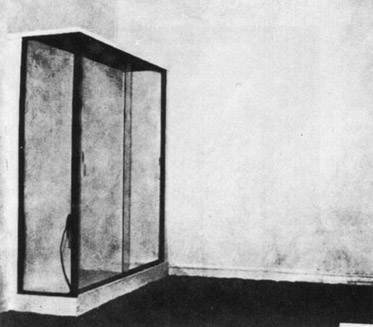
In response to Yves Klein's works centered on the concept of Le Vide, e.g.

 ...Arman filled a gallery with garbage, calling it Le Plein (basically, "The Full"):
From this, then, came a series called Poubelles which were large glass boxes with collections of junk (some "garbage" some not) in them. The decollages are more directly related to what I'm making now but the Poubelles seems like a perfect predecessor to something we could/should make, Adrian.


Anyway, that's where my head's at right now. Let me know what this stuff does for you guys.
P.S. Google "trash" and you get a map of your city with lots of destinations.
P.P.S. Thought I'd give this a shot; efforts thwarted though. How appropriate (click to enlarge):
PPPS#!&: Lizzie check out this crazy ish! EYE TRACKING. Relates to our computer installation/multi-feed video surveillance ideas right??

(In the pieces I've made the opacity of the ads is all very low so they are all sort of visible and invisible/unreadable/transparent at the same time, which seems like an appropriate progression from the technique of Nouveau Realists like Jacques de la Villegle and Raymond Hains (above).) Anyway, I'll have more to say about my stuff when I put it up but this line of research reminded me of the artist Arman who was also in this group but made mostly sculptures and collections of objects. (He also did stuff like make "paintings" using paintbrushes like this version of Van Gogh's Starry Night.)

In response to Yves Klein's works centered on the concept of Le Vide, e.g.

 ...Arman filled a gallery with garbage, calling it Le Plein (basically, "The Full"):
From this, then, came a series called Poubelles which were large glass boxes with collections of junk (some "garbage" some not) in them. The decollages are more directly related to what I'm making now but the Poubelles seems like a perfect predecessor to something we could/should make, Adrian.


Anyway, that's where my head's at right now. Let me know what this stuff does for you guys.
P.S. Google "trash" and you get a map of your city with lots of destinations.
P.P.S. Thought I'd give this a shot; efforts thwarted though. How appropriate (click to enlarge):

PPPS#!&: Lizzie check out this crazy ish! EYE TRACKING. Relates to our computer installation/multi-feed video surveillance ideas right??
Subscribe to:
Posts (Atom)